
Introduction
Firefighting foam systems are one of the most effective solutions for protecting facilities where flammable or combustible liquids are present. Industries such as oil and gas, petrochemical, fuel storage, and logistics terminals require systems capable of controlling Class B fires, where water alone is insufficient.
The National Fire Protection Association establishes in NFPA 11 the criteria for the design, installation, and operation of low-, medium-, and high-expansion foam systems.
Operating Principle
Firefighting foam is generated by mixing water, foam concentrate, and air. This mixture produces a blanket of bubbles that performs three main functions:
• suppresses the fire by isolating oxygen
• cools the fuel surface
• prevents the release of flammable vapors
Main System Components
A typical system includes:
• foam concentrate storage tank
• proportioning system or premix system
• piping network
• control valves
• discharge devices (nozzles or foam chambers)
• detection and activation system
In modern facilities, system activation is typically integrated with fire and gas detectors connected to control panels.
Design Criteria
System design depends on several factors:
a) Type of hazard
• hydrocarbon storage
• process areas
• containment dikes
• loading areas
b) Type of foam (most commonly used)
• AFFF (Aqueous Film Forming Foam)
• AR-AFFF (Alcohol-Resistant AFFF)
• FP/FFFP (Fluoroprotein / Film-Forming Fluoroprotein)
c) Application considerations
Firefighting foam is primarily classified by its expansion ratio (low, medium, or high) and concentration (1%, 3%, 6%), rather than by physical density, since its function is to cover or flood combustible surfaces.
The most common types based on expansion include:
Low expansion (<20:1): Highly mobile, ideal for flammable liquid fires (AFFF, FP), covering large surfaces quickly.
Medium expansion (20:1 – 200:1): Used for indoor applications and vapor control.
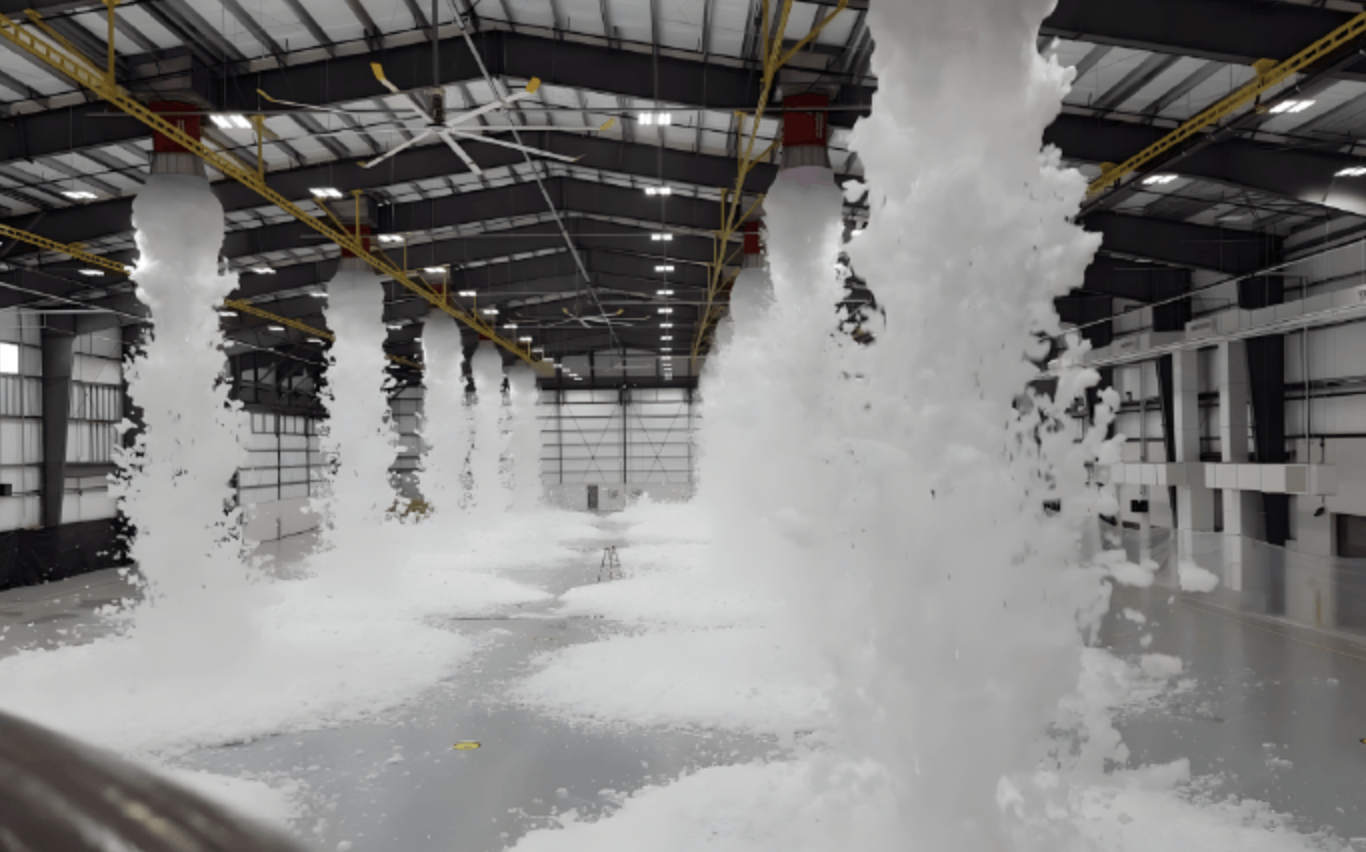
High expansion (200:1 – 1000:1): Designed for total flooding of enclosed spaces such as hangars, suppressing fire with dry foam bubbles.
Typical Concentrations
• 3%: Three parts concentrate to 97 parts water, commonly used for hydrocarbons
• 6%: Six parts concentrate to 94 parts water, frequently used for polar solvents
• 1%: Used in specialized concentrates for hydrocarbons
For low-expansion foam, typical values are:
| Tipo de riesgo | Density |
| Hydrocarbons | 4.1 – 6.5 L/min/m² |
| Polar Solvents | hasta 8.1 L/min/m² |
d) Hydraulic Considerations
The system must ensure:
• minimum pressure at discharge devices
• required flow rate
• minimum discharge duration
Hydraulic calculations must consider:
• friction losses
• elevation
• nozzle discharge coefficients
Conclusion
Properly designed foam systems allow fire control at early stages, reduce damage to facilities, and protect personnel safety. The rigorous application of NFPA standards ensures adequate system performance under critical conditions.
References
• NFPA 11
• NOM-006-ASEA-2017
Contact Us
If you require support for engineering development, design, evaluation, or regulatory compliance in fire protection systems, our team can assist you in developing specialized technical solutions for your project.